Project Overview
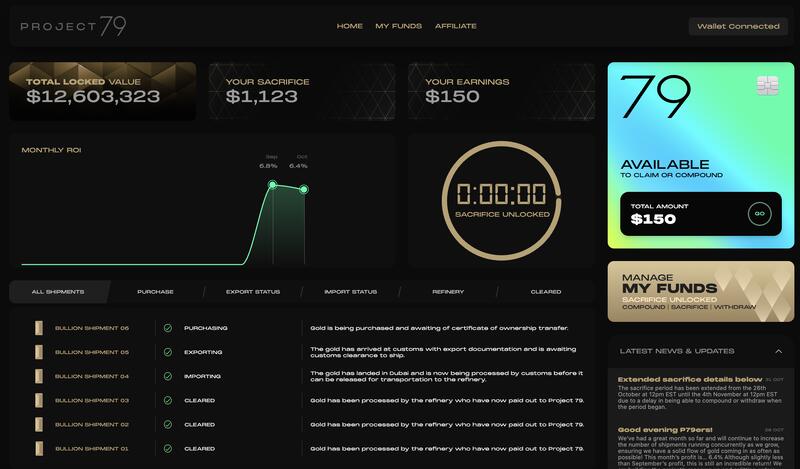
Project79 started with a straightforward but technically demanding brief: build a DeFi platform that lets everyday investors put money into gold-backed assets using stablecoins and receive monthly returns automatically — without trusting a company to do the right thing with their funds. That last part is what makes it a blockchain problem rather than a fintech problem. I built the platform from the ground up over 26 months, designing the smart contract architecture, deploying across four EVM chains, building the referral engine, and shipping the Next.js frontend that makes it all accessible to investors who have never touched a DeFi protocol before. By the time the engagement closed, the platform had raised over $12.6M from 3,200+ active investors and maintained 100% uptime without a single security incident — the kind of track record that only comes from getting the architecture right at the start rather than patching it as you go.
Key Features
- Multi-chain investment support across Ethereum, BSC, Polygon, and Arbitrum — giving investors flexibility on fees, speed, and preferred network without managing separate platforms for each chain
- Stablecoin-based deposits accepting USDT, USDC, and BUSD, eliminating crypto volatility from the investment side and simplifying ROI accounting
- Fully automated 8–9% monthly ROI calculation and distribution via smart contracts — payouts run on schedule without admin approval, manual triggers, or human involvement
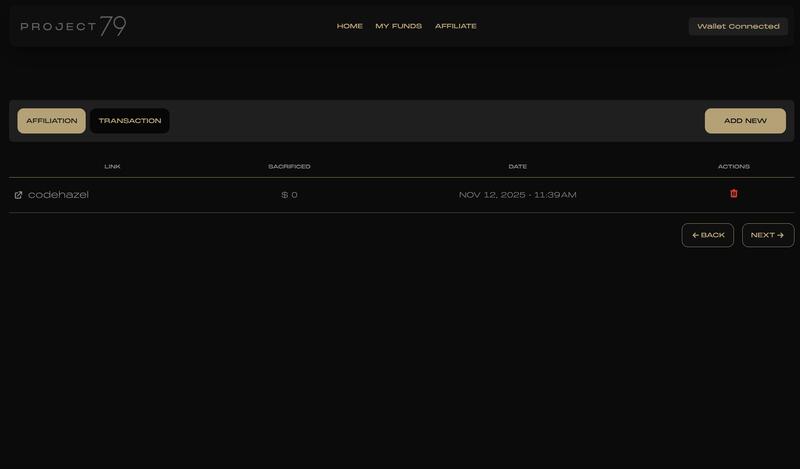
- Decentralized referral engine with unique referral IDs, on-chain attribution tracking, and automated commission payouts that scale without reconciliation overhead
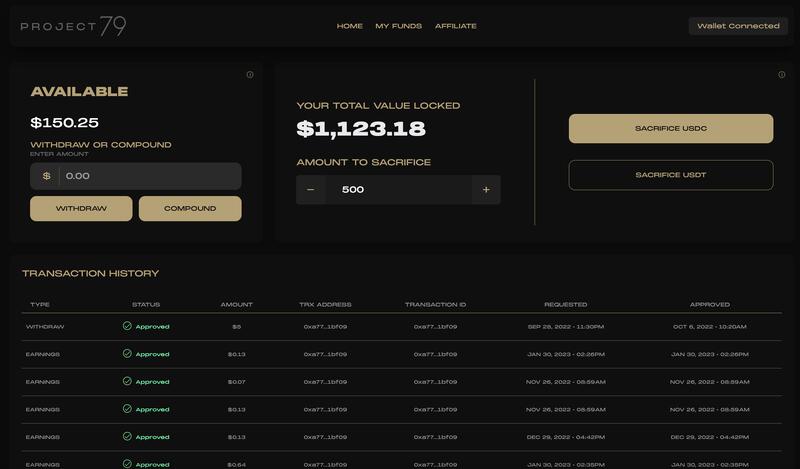
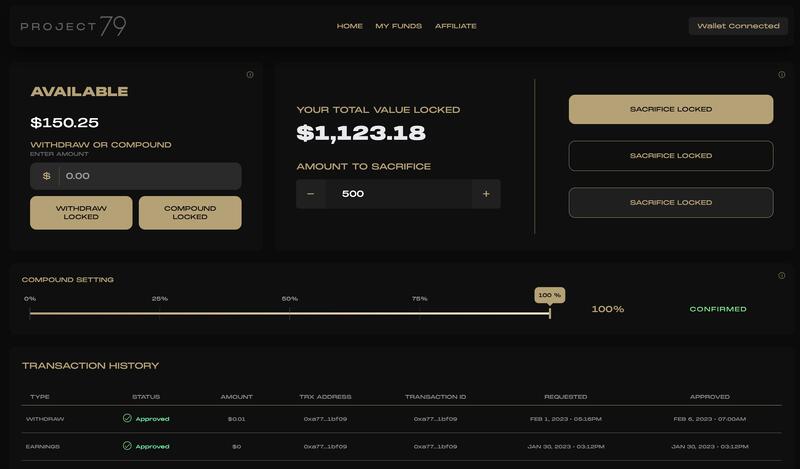
- Fund management tools enabling investors to transfer between projects, reinvest earnings, and optimize portfolio allocation directly from the dashboard
- Complete on-chain transaction history for both personal investments and referral activity, giving investors full visibility into every fund movement
- Next.js investor dashboard with real-time portfolio tracking, referral performance, and seamless Web3 wallet connectivity via MetaMask and WalletConnect
Technical Implementation
The foundation of Project79 is a unified Solidity smart contract system engineered to deploy identically across four EVM chains — Ethereum, BSC, Polygon, and Arbitrum — with consistent logic, access controls, and gas optimization on each network. Rather than maintaining separate contract codebases per chain, the architecture uses a single audited implementation with chain-specific deployment configurations, which made ongoing maintenance and security updates manageable across all four networks simultaneously. Automated ROI distribution runs entirely on-chain: the contracts calculate each investor's monthly return based on their deposit amount and timing, then execute payouts in USDT, USDC, or BUSD without any off-chain trigger. The referral system assigns unique referral IDs at the wallet level and records attribution on-chain at the moment of first deposit — making commissions deterministic, immutable, and impossible to dispute. The Next.js frontend abstracts all of this into three actions for the investor: connect wallet, deposit, track earnings. Network switching happens automatically based on wallet detection. Security architecture separates mission-critical financial logic — deposits, distributions, referral payouts — onto the chain, while dashboards and analytics operate off-chain for performance, ensuring the financial layer is always verifiable regardless of frontend availability.
Challenges & Solutions
Running a live investment platform across four blockchains for 26 months surfaces failure modes that shorter projects never encounter. Block time variability between Ethereum, BSC, Polygon, and Arbitrum means monthly ROI cycles don't tick over at the same moment on every chain — the distribution logic had to account for this without creating payout timing inconsistencies across networks that investors would notice and question. Gas cost differences between chains also affect the economics of small deposits differently depending on network congestion; the contract architecture was designed to remain gas-efficient even on Ethereum mainnet where costs are highest. The referral engine's integrity was another long-term challenge: over 26 months, edge cases accumulate — investors who switch wallets, referrals who reinvest under different conditions, commission calculations that need to stay consistent as the investor base grows past 3,000 participants. On-chain attribution recorded at first deposit made every referral relationship permanent and auditable, which prevented the attribution disputes that would otherwise require admin intervention to resolve. Keeping 100% uptime over that duration required the frontend and smart contract infrastructure to be treated as production systems with monitoring and fail-safe logic, not MVP deployments that get fixed when something breaks.
Results & Impact
Project79 raised over $12.6M from 3,200+ active investors across a 26-month live deployment — the largest fundraising outcome in this portfolio by a wide margin. Monthly ROI distribution of 8–9% was delivered consistently through automated smart contracts with zero manual payouts executed by the team at any point during the engagement. The platform maintained 100% uptime across all four supported chains for the full duration of the project, a reliability record that matters specifically for an investment platform where downtime during a distribution window directly affects investor trust. The decentralized referral system supported organic growth without marketing spend by automating commission attribution and payouts for an expanding referral network. This project represents the longest and highest-value DeFi engagement in the portfolio — and the infrastructure is still standing as proof of what the architecture was built to handle.