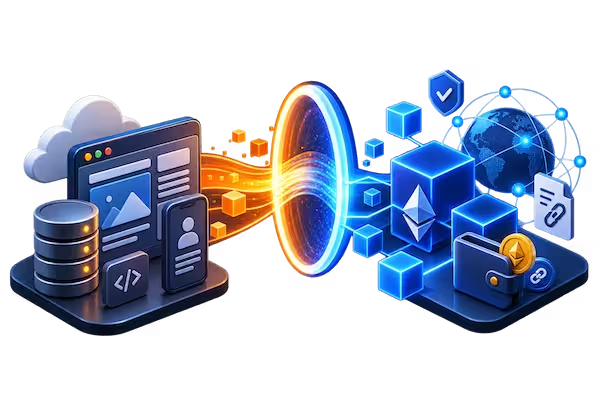
Web3 didn't fail in 2026 — the 2021 hype cycle did. Walmart traces products in 2.2 seconds, JPMorgan's settled hundreds of billions on-chain, and none of it needed a token launch. Here's what a real Web2-to-Web3 migration actually looks like — and what it costs.
What Does “Web2 to Web3” Actually Mean?
Moving from Web2 to Web3 means shifting an application’s trust layer — who owns the data, who controls the login, who gets paid — from a company’s private server to a public blockchain. In practice, that usually means adding wallet-based login, putting ownership records (tokens, credentials, payments) on-chain, and letting users hold their own keys instead of a company holding an account for them. You don’t have to throw out your existing stack to do it. Most teams bolt Web3 features onto a Web2 backend rather than rebuilding from scratch, and that hybrid approach is exactly what’s working for enterprises right now.
That’s the short version. The long version is messier, because “Web3” got dragged through a hype cycle, a crash, and a quiet rebuild — and understanding where things actually stand in 2026 matters more than the buzzword itself.
Web2 vs Web3: The Fundamental Differences
Before touching any code, it helps to be precise about what’s changing. Here’s the split that actually matters for a migration project, not the philosophical version:
Web2 vs Web3 at a Glance
| Web2 | Web3 | |
|---|---|---|
| Data ownership | Held by the platform (AWS, Firebase, or private databases) | Controlled by users via wallets and private keys |
| Identity | Email/password, OAuth logins | Wallet address or decentralized identity (DID) |
| Payments | Banks, Stripe, card networks | Crypto tokens, stablecoins, smart contracts |
| Backend logic | Runs on centralized servers | Executed via smart contracts on blockchain |
| Trust model | Trust the company/platform | Trust code and consensus mechanisms |
| Failure mode | Service shutdown or data loss if company fails | Smart contract bugs are permanent unless upgradeable design is used |
Web3 removes a middleman, but it also removes the safety net that middleman provided. That’s the conversation to have with a client before quoting a migration project — not after.
Is Web3 Actually Here Yet?
Depends who you ask, and that’s a fair answer rather than a dodge. Speculative Web3 — the NFT-avatar, DAO-governance, metaverse-land version — mostly collapsed by 2023. What replaced it is quieter and considerably more boring: tokenized settlement, supply-chain verification, and identity infrastructure running inside companies that never bothered with a whitepaper.
The 2026 numbers back this up. Walmart’s blockchain-based food-tracking system, built with IBM, now traces products in about 2.2 seconds — a process that used to take close to a week. JPMorgan’s Onyx platform has settled tokenized money-market transactions well into the hundreds of billions of dollars, and Mastercard has pushed tokenization across roughly a third of its global payment volume. None of that made headlines the way a bored-ape sale did in 2021, but it’s a far more durable signal of adoption. The World Economic Forum has pointed to clearer regulation and improving interoperability as the reason 2026 looks like a genuine turning point for blockchain infrastructure rather than another speculative bump.
So: are we “in” Web3 now? Not in the consumer-facing, everyone-has-a-wallet sense. In the enterprise-infrastructure sense, yes — quietly, and mostly without the branding.
Why Did the First Wave of Web3 Fail?
Three reasons, and they’re worth naming plainly instead of glossing over:
- The UX was hostile. Seed phrases, gas fees, and wallet pop-ups are a terrible first impression for anyone who isn’t already a crypto user.
- The value proposition was backwards. Most 2021-era projects launched a token first and looked for a use case second. That’s the opposite order of a healthy product.
- Regulatory uncertainty scared off serious capital. Enterprises don’t build on infrastructure they might get sued over, and for a couple of years that was a live risk.
The projects surviving into 2026 fixed at least two of those three. Chain abstraction and embedded wallets solve the UX problem by letting users transact without knowing they’re touching a blockchain at all. And regulatory clarity in major markets has made legal teams far more comfortable signing off on production deployments.
What Does Elon Musk Think of Web3?
This one comes up constantly, so it’s worth answering directly instead of dodging it. Musk has been publicly skeptical for years — back in late 2021 he wrote that Web3 “seems more marketing buzzword than reality right now,” and followed it up a day later asking whether anyone had actually seen it (source). Jack Dorsey piled on around the same time, arguing that venture capital firms — not users — ended up owning most of what Web3 promised to decentralize.
That skepticism hasn’t really softened, and it’s a useful check on the industry’s own hype. But it’s worth separating “the 2021 speculative version of Web3 was overhyped” — which even a lot of Web3 builders now agree with — from “blockchain infrastructure has no enterprise value,” which the Walmart and JPMorgan numbers above make a harder argument to sustain. In 2026, Web3’s growth is increasingly driven by tokenization, stablecoins, and regulated enterprise deployment rather than retail speculation — which is a fairly direct answer to Musk’s original complaint.
How to Convert a Web2 App Into Web3 (Step-by-Step)
If you’re actually planning a migration, here’s the realistic sequence — not the theoretical one:
- Identify what genuinely needs to be on-chain. Not everything does. Ownership records, payments, and audit trails benefit from blockchain. User profiles, session data, and UI state usually don’t.
- Keep your existing backend for everything else. Almost no successful migration is a full rebuild. Your database, your APIs, your auth layer for non-wallet users — most of that stays.
- Add wallet-based auth alongside your current login, not instead of it. Sign-In With Ethereum (SIWE) or a wallet SDK can sit next to your existing OAuth flow.
- Choose your chain and infrastructure layer based on cost and transaction volume, not hype. Layer-2 networks now handle most consumer-facing Web3 apps because gas costs on mainnet are still a dealbreaker for casual users.
- Write and audit your smart contracts before anything touches real funds. This is non-negotiable — an unaudited contract holding user assets is the single biggest liability in a Web3 migration.
- Pilot with a narrow, high-value use case — a loyalty program, a certificate of authenticity, a single payment flow — rather than converting the whole product at once.
- Measure adoption before expanding. If your pilot users aren’t connecting wallets, the problem is almost always onboarding friction, not the underlying tech.
Are you looking for a developer?
Explore dedicated development expertise and professional website services for your next project.
Best Platforms and Tools for a Web2-to-Web3 Migration in 2026
The infrastructure layer has matured a lot since the 2021 gold rush, and picking the right tool now depends on what you’re actually short on:
- Thirdweb — the fastest path to shipping wallets, tokens, and payment flows if your bottleneck is speed-to-launch rather than infrastructure depth.
- Alchemy — the safer pick when reliability and node infrastructure matter more than how fast you can ship a prototype.
- Moralis — strongest when your product leans on indexed on-chain data (wallet balances, NFT metadata, cross-chain activity) and your team already knows REST APIs.
- Chainlink — the standard for pulling real-world data (prices, events, verification) onto a chain reliably.
- Fireblocks — worth a look if you’re handling institutional-grade custody rather than consumer wallets.
None of these require you to abandon your existing stack. Most plug into a Node.js or Python backend the same way a payments API would.
What Does Moving From Web2 to Web3 Cost?
Wide range, and anyone quoting a single number without asking about scope first isn’t being straight with you. A narrow pilot — one smart contract, wallet login bolted onto an existing app, a basic token or NFT layer — typically lands somewhere in the low tens of thousands of dollars. A full enterprise-grade platform with custom contracts, multi-chain support, security audits, and ongoing infrastructure can run well past $250,000. Security audits alone are not optional line items to cut — a single contract exploit tends to cost far more than the audit that would have caught it.
Real Businesses Already Making the Shift
Skepticism aside, the production examples are worth naming because they’re not speculative:
- Walmart and IBM’s food-traceability system, cutting investigation time from days to seconds.
- JPMorgan’s Onyx platform, processing tokenized institutional settlement at scale.
- Mastercard, tokenizing a meaningful share of global payment volume.
Deloitte’s overview of enterprise blockchain adoption is a useful read if you want the case for adoption made by a firm with no token to sell — which is part of why it’s more convincing than most crypto-native sources.
Web2 vs Web3 for Business Owners: Is It Worth It?
Worth it if you have a specific problem — ownership verification, cross-party trust, payment settlement across borders — that blockchain solves better than a database with an API in front of it. Not worth it if the honest answer is “our competitors are doing something with Web3 and we don’t want to look behind.” That second reason built most of the projects that quietly died in 2022, and it’s still the wrong reason in 2026.
Frequently Asked Questions
What does 'Web2 to Web3' actually mean?
It means shifting who controls the trust layer of your app — data ownership, login, and payments — from your private servers to a public blockchain. Most teams add Web3 features on top of their existing stack — a full rebuild is rarely necessary.
Is Web3 actually here yet, or are we still waiting?
Depends where you look. Consumer Web3 is still early, but enterprise infrastructure is already running in production.
Why did Web3 fail the first time around?
Three reasons: hostile UX, token-first products with no real use case, and regulatory uncertainty that scared off serious capital.
What does Elon Musk think of Web3?
He's been publicly skeptical since 2021, calling it "more marketing buzzword than reality." His criticism targeted the speculative wave, not today's enterprise use cases.
What are the best platforms for a Web2-to-Web3 migration?
Thirdweb for speed to launch, Alchemy for infrastructure reliability, and Moralis for indexed on-chain data — the right pick depends on your bottleneck. None of these require abandoning your current backend.
How much does it cost to move from Web2 to Web3?
A narrow pilot typically runs in the low tens of thousands; a full enterprise platform with audits and multi-chain support can pass $250,000+.
How can I integrate blockchain into an existing application?
Add wallet-based auth alongside your current login, keep your database and APIs as-is, and put only ownership, payments, or audit trails on-chain.
Are any real businesses actually using Web3 today?
Yes — Walmart traces products in 2.2 seconds with blockchain, and JPMorgan's Onyx platform has settled tokenized transactions at massive scale. These are production deployments, not just pilots or press releases.
What services help onboard everyday users into Web3?
Embedded wallets and account-abstraction tools, like Thirdweb and Sequence, let new users transact without ever seeing a seed phrase.
Is a Web2-to-Web3 migration worth it for my business?
Only if you have a specific problem — cross-party trust, ownership verification, or payment settlement — that blockchain solves better than a database ever could.
The Bottom Line
Web3 didn’t fail — the 2021 version of it did. What’s left in 2026 is smaller, less flashy, and considerably more useful: tokenized settlement, verifiable ownership, and infrastructure that enterprises are quietly building into systems that already work. If you’re weighing a migration, start with one problem worth solving on-chain, keep the rest of your stack exactly as it is, and resist any pitch that starts with the token instead of the use case.


%20Logo.avif)