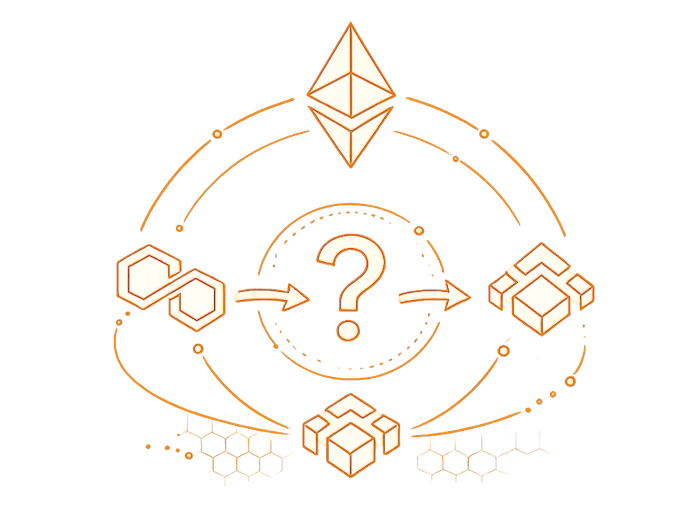
Ethereum, Polygon, and BSC all run smart contracts and speak the same EVM language, but they're built for different jobs, not the same race. Ethereum is the settlement layer — secured by over a million validators, expensive to use, and trusted with real money for exactly that reason. Polygon is the everyday chain: transactions confirm in about two seconds and often cost less than a cent, which is why high-volume apps like Polymarket run almost entirely on it. BSC sits in between, cheap and fast like Polygon but leaning on a much smaller validator set and closer ties to Binance. None of them is the outright "winner" — the right pick depends on whether you're settling something valuable, building a high-frequency app, or just trying to avoid a $40 gas fee. Below, we break down fees, speed, security, bridging, and wallets with real 2026 numbers so you can decide for yourself.
If you’ve ever tried to send $20 worth of crypto and watched $8 of it disappear into a gas fee, you already understand why this comparison matters. Ethereum, Polygon, and BSC (BNB Smart Chain) all run smart contracts, all speak the same EVM language, and all show up in the same “which chain should I use” conversation — but they solve completely different problems.
Short version: Ethereum is the settlement layer you trust with real money. Polygon is the everyday chain built for cheap, fast, high-volume activity. BSC sits in between — fast and cheap like Polygon, but with a smaller, more centralized validator set and closer ties to Binance. None of them is “the winner” outright. The right one depends on what you’re actually doing — trading, gaming, payments, or building.
Here’s the breakdown, with real numbers, not vibes.
Ethereum vs Polygon vs BSC at a Glance
| Ethereum | Polygon | BSC | |
|---|---|---|---|
| Type | Layer 1 (base settlement) | Ethereum-linked sidechain / scaling stack | Independent Layer 1 |
| Typical fee | $0.87–$3 (spikes to $10–$50) | Often under $0.01 | Roughly $0.10–$0.60 |
| Confirmation | ~12 seconds per block, finality in minutes | ~2 seconds | ~3 seconds |
| Validators | 1M+ staked validators | Own PoS validator set + Ethereum checkpoints | 21–45 active validators |
| Best for | High-value DeFi, institutional settlement | Payments, gaming, prediction markets, NFTs | Fast, cheap retail trading and dApps |
That table is the whole article in miniature. Now let’s dig into why the numbers look like that.
Differences in Transaction Fees Between Ethereum, Polygon, and BSC
Fees are where most people feel the difference first, and they feel it fast. On Ethereum mainnet, a basic transfer can run $0.87 to $3 depending on how congested the network is, and that’s before you touch anything more complex. Try to swap tokens on Uniswap during a busy stretch and you’re looking at $10 to $50 in gas. Mint an NFT when everyone else is trying to mint the same collection, and you could be staring down a $50–$150 bill just to click confirm.
Polygon flips that entirely. Because it processes transactions off Ethereum’s main chain and settles in batches, everyday transfers routinely cost less than a cent. That’s not marketing spin — it’s why Polymarket, currently one of the most active applications in crypto, runs almost entirely on Polygon. A prediction market where users place, adjust, and settle bets constantly simply can’t function on Ethereum-mainnet pricing.
BSC lands in the middle. It’s not as close-to-free as Polygon, but it’s still a fraction of Ethereum’s cost — typically $0.10 to $0.60 for a standard transaction, and around $0.30–$0.60 for something like a DeFi swap. Binance built BSC to feel like a “budget Ethereum,” and on fees, that’s exactly what it delivers.
The takeaway: if you’re moving small amounts often, Ethereum mainnet will eat your returns. Polygon and BSC exist specifically to fix that.
Which Platform Offers the Fastest Transaction Speeds?
Speed and fees usually move together, and that holds true here. Ethereum settles a block roughly every 12 seconds, and while that’s plenty fast for a large trade you’re not in a hurry about, it’s not built for rapid-fire dApp interactions. Full finality — the point where a transaction is essentially unchangeable — takes a few minutes.
Polygon is the speed leader of this trio in daily use. Confirmations typically land in about 2 seconds, and Polygon’s “Gigagas” roadmap is explicitly chasing six-figure transactions-per-second targets to position the network as payment-rail infrastructure — the kind of throughput you’d want behind a Visa-scale system, not just a DeFi app. Recent upgrades have already pushed capacity toward the thousands-of-TPS range, with more planned through 2026.
BSC isn’t far behind on the user-facing side, with blocks landing roughly every 3 seconds. It won’t out-throughput Polygon at scale, but for the average swap or game transaction, the difference is barely noticeable to a human being tapping “confirm” on their phone.
For dApp interactions specifically — gaming, prediction markets, anything with rapid back-and-forth — Polygon currently has the edge, with BSC a close second and Ethereum mainnet a distant third unless you’re settling something high-value.
How to Bridge Assets Between Ethereum, Polygon, and BSC
Bridging just means moving a token from one chain to another, and it’s one of the more nerve-wracking parts of using multiple chains — mostly because bridges have historically been a favorite target for hackers. The BNB Chain bridge exploit in October 2022, which drained roughly $570 million before validators froze the chain, is the cautionary tale everyone in this space still references.
A few practical routes:
- Ethereum ↔ Polygon: Use the official Polygon Portal (bridge.polygon.technology). It’s the most battle-tested option and directly supported by the Polygon team.
- Ethereum ↔ BSC: Binance Bridge or the Binance exchange itself (deposit on one chain, withdraw on the other) is usually simpler than a third-party bridge for most users.
- Cross-chain, any direction: Tools like Wormhole, deBridge, and Stargate support Ethereum, Polygon, and BSC in a single interface, which is handy if you’re hopping between all three regularly.
- General rule: stick to bridges with a long track record and an active bug-bounty program. If a bridge is brand new or promising unusually high yields for “wrapping” your assets, that’s a red flag, not a bonus.
One more thing worth knowing: because all three chains are EVM-compatible, your wallet address looks identical across them. What changes is the network you’ve selected inside your wallet — not the address itself.
Best Wallets Compatible With Ethereum, Polygon, and BSC
The good news here is that EVM compatibility makes wallet choice simple. Almost every major wallet supports all three networks natively or with a quick manual network add.
- MetaMask — the default choice for most people. Ethereum is built in; Polygon and BSC take about 30 seconds to add via Chainlist.org.
- Trust Wallet — supports all three out of the box, no manual setup, and it’s the wallet Binance pushes hardest for BSC users specifically.
- Rabby Wallet — built for multi-chain users; it auto-detects which network a dApp needs and switches for you, which saves a surprising amount of friction once you’re juggling three chains.
- Coinbase Wallet — solid all-around option with a cleaner mobile experience than MetaMask, plus built-in support for all three networks.
- Ledger / Trezor (hardware) — for anything you’re not actively trading, pair a hardware wallet with MetaMask or Trust Wallet as the interface. Your seed phrase doesn’t change between chains, but your security posture should scale with your balance.
If you’re only going to install one wallet, MetaMask with Polygon and BSC added as custom networks covers 95% of use cases.
Evaluating the Security Architecture of Each Network
This is the category where the three chains genuinely diverge, not just in numbers but in philosophy.
Ethereum runs on proof-of-stake with well over a million validators securing the network. That scale of decentralization is expensive to attack and slow to change — which is precisely the point. It’s why institutional DeFi and high-value settlement still default to Ethereum mainnet even when the fees sting.
Polygon PoS is technically a sidechain rather than a true Layer 2 — it runs its own validator set (roughly 100 validators) and periodically checkpoints back to Ethereum for an added security layer. Its newer zkEVM infrastructure inherits Ethereum’s security more directly through zero-knowledge proofs, though Polygon actually announced the wind-down of its standalone zkEVM network in 2026 as it consolidates around the AggLayer instead.
BSC trades decentralization for speed. It runs on a much smaller set of 21 to 45 active validators, many with ties to Binance. That’s a big part of why it’s fast and cheap — fewer nodes to reach consensus with — but it’s also why BSC has been a more attractive bridge-hack target historically, and why serious critics point to validator concentration as a real trust trade-off.
None of this means BSC is “unsafe” for everyday use. It means the risk profile is different, and it should factor into how much value you’re comfortable parking there long-term versus using for active trading.
Scalability Solutions Across the Three Ecosystems
Ethereum’s scaling strategy isn’t about changing the base layer much — it’s about pushing activity onto Layer 2s (Arbitrum, Base, Optimism, and Polygon’s zkEVM among them) while Ethereum itself focuses on being a secure settlement backbone. Upgrades like proto-danksharding have made it cheaper for those L2s to post data back to mainnet, which indirectly lowers costs across the whole ecosystem.
Polygon’s approach is broader than people expect. It’s no longer just “cheap Ethereum” — it’s a stack that includes Polygon PoS, the AggLayer (which unifies liquidity across multiple chains so they feel like one network to users), and Polygon CDK for teams building their own custom chains. The AggLayer piece is arguably Polygon’s biggest 2026 bet: rather than competing chain-by-chain, it’s trying to make multi-chain feel invisible to the end user.
BSC’s scaling play is opBNB, an optimistic-rollup Layer 2 built on top of BNB Smart Chain, aimed at pushing fees down even further for high-frequency use cases like gaming.
Cost-Effective Alternatives for Deploying Smart Contracts
If you’re a developer deciding where to deploy rather than a user deciding where to transact, cost changes the calculus. Deploying and running a contract on Ethereum mainnet can cost real money just in gas for testing and iteration — painful when you’re still validating product-market fit. Polygon and BSC both let you deploy the exact same Solidity contract (that’s the benefit of EVM compatibility) for a fraction of the cost, which is why so many projects prototype on Polygon or BSC and only move high-value functions to Ethereum mainnet once they’re proven out.
Frequently Asked Questions
Is Polygon better than Ethereum?
Not better — different. Polygon is faster and dramatically cheaper for everyday transactions, but it depends on Ethereum for ultimate security. Think of Polygon as the checkout counter and Ethereum as the bank vault behind it.
Is Polygon faster than Ethereum?
Yes, considerably. Polygon confirms transactions in roughly 2 seconds versus Ethereum’s ~12-second block time and multi-minute finality window.
Is BSC built on Ethereum?
No. BSC is its own independent Layer 1 blockchain built by Binance. It’s EVM-compatible, which means it can run Ethereum-style smart contracts, but it doesn’t settle transactions back to Ethereum the way Polygon does.
Is Polygon a dead crypto?
No, though POL (Polygon’s token) has had a rough stretch, with heavier competition from Arbitrum and Base eating into its earlier first-mover lead. Network activity tells a different story than the token price — Polygon has been posting record transaction burns and is the primary chain behind Polymarket, one of crypto’s most active apps in 2026. Token price and network usage aren’t always the same conversation.
Is BSC better than Solana?
They’re built for slightly different audiences. BSC leans on EVM compatibility and Binance’s massive user base, so it’s an easier on-ramp for anyone coming from Ethereum tooling. Solana runs on entirely different architecture and generally posts even lower fees and higher raw throughput, but it isn’t EVM-compatible, so it requires separate tooling and smart-contract languages.
What are the top cryptos in this comparison right now?
Ethereum (ETH), Polygon (POL), and BNB remain the tokens tied to these three networks. This isn’t investment advice — token value depends on far more than network fees or speed, including tokenomics, competition, and broader market conditions, so treat any price prediction with real skepticism.
Which Chain Should You Actually Use?
Here’s the honest answer, not the diplomatic one. If you’re settling something valuable and can tolerate paying for security, use Ethereum. If you’re paying for coffee-money-sized transactions, gaming, or building something users will interact with dozens of times a day, Polygon is the more mature, more secure choice among the low-cost options right now. BSC is a reasonable middle ground if you’re already living in Binance’s ecosystem or want a fast, cheap chain with a massive existing user base — just go in aware that its validator set is smaller and more concentrated than the other two.
None of these chains are going away in 2026. The real shift is that fewer people are picking one and sticking with it — they’re using whichever chain fits the transaction in front of them, and switching without a second thought.
Sources referenced: CoinGecko Polygon Ecosystem Report, CoinMarketCap Polygon Network Updates
Frequently Asked Questions
Is Polygon better than Ethereum?
Not better — different jobs. Polygon is faster and far cheaper for everyday transactions, but it still leans on Ethereum for ultimate security. Polygon is like the checkout counter, while Ethereum is the vault behind it.
Is Polygon faster than Ethereum?
Yes. Polygon confirms transactions in about 2 seconds, versus Ethereum's ~12-second block time and multi-minute finality window.
Is BSC built on Ethereum?
No. BSC is its own independent Layer 1 built by Binance — it's EVM-compatible, but it doesn't settle back to Ethereum the way Polygon does.
What are the differences in transaction fees between Ethereum, Polygon, and BSC?
Ethereum typically runs $0.87–$3 (spiking to $50+ when busy), Polygon is often under $0.01, and BSC sits around $0.10–$0.60. Polygon is the cheapest of the three by a wide margin.
What wallets are compatible with Ethereum, Polygon, and BSC?
MetaMask, Trust Wallet, Rabby, and Coinbase Wallet all support every chain here — the same address works across all three, you just switch networks.
How do I bridge assets between Ethereum, Polygon, and BSC?
Use the official Polygon Portal for Ethereum-Polygon transfers, Binance Bridge for BSC, or a cross-chain tool like Wormhole for either direction. Stick to bridges with a long track record — bridges are the top hack target.
Which network has the strongest security architecture?
Ethereum, by a clear margin — it's secured by over 1 million validators. Polygon checkpoints to Ethereum with ~100 validators; BSC runs on just 21–45 validators.
Is Polygon a dead crypto?
No — though the POL token has struggled against competition from Arbitrum and Base. Network usage tells a different story, with Polygon powering Polymarket, one of crypto's most active apps.
Is BSC better than Solana?
They serve different audiences. BSC is EVM-compatible and easier for Ethereum developers to pick up; Solana isn't EVM-based but generally posts lower fees and higher raw throughput.
What's the most cost-effective chain for deploying smart contracts?
Polygon or BSC — both run the same Solidity contracts as Ethereum for a fraction of the gas cost, which is why most teams prototype there before moving high-value functions to mainnet. Same code, dramatically lower deployment cost.


%20Logo.avif)