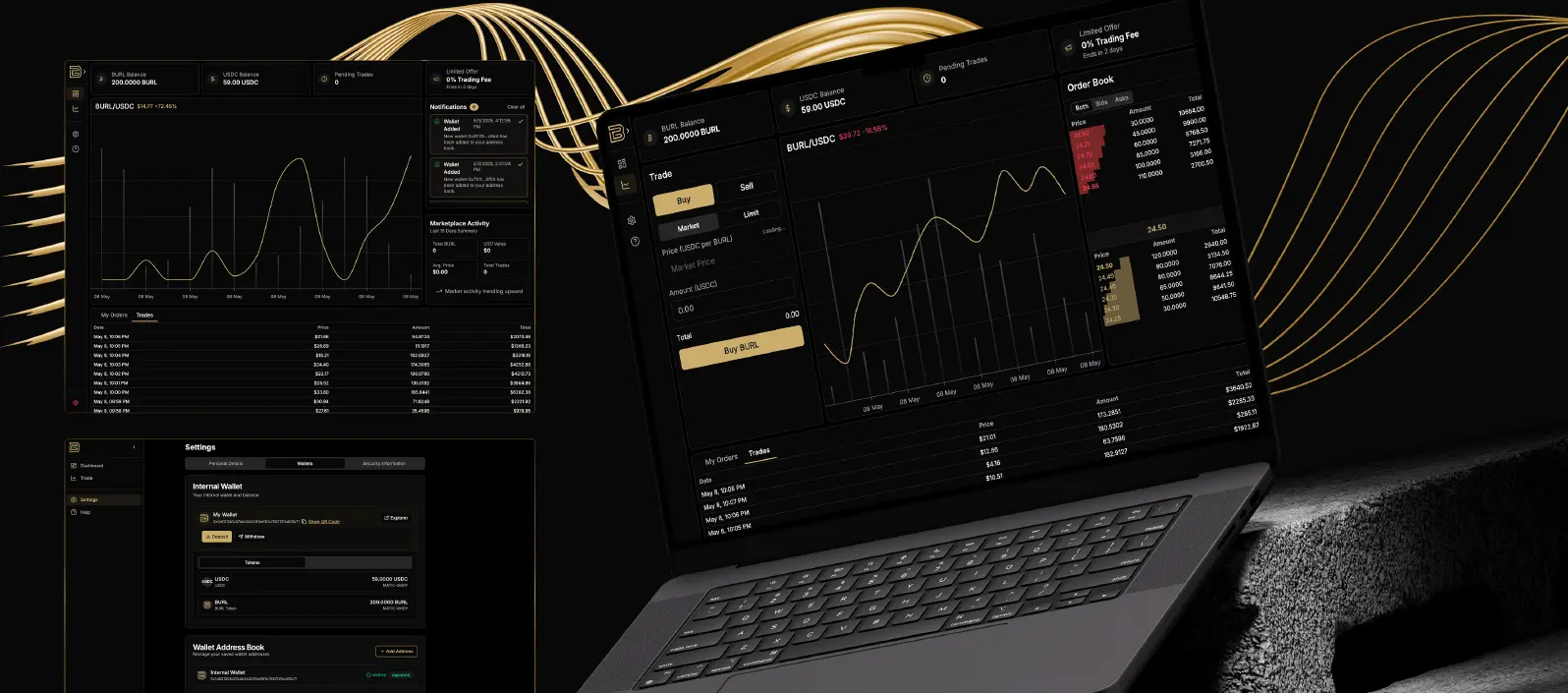
Project Overview
Burlcore presented an interesting challenge: build a marketplace where people can trade a token tied to real-world mining output — not just speculate on price, but exchange fractional ownership in something tangible. That meant the platform needed to feel trustworthy even without a central authority deciding who gets what. We built the whole thing around escrow-backed transaction flows, so neither the buyer nor the seller has to trust each other directly — the escrow contract handles that. As lead full-stack developer, I was responsible for everything from the trading engine and database architecture to the Web3 integration and real-time order book.
Key Features
- Peer-to-peer trading with escrow protection on every transaction
- Dynamic order book with live trade history tracking
- Wallet and balance monitoring with high data integrity across concurrent sessions
- Fully auditable transaction flows with traceable state transitions
- Admin and operations monitoring panel for platform oversight
Technical Implementation
The frontend was built with Next.js and React, chosen for their performance and server-side rendering capabilities — important for a trading interface where load speed affects user trust. The backend leans on Supabase and PostgreSQL, with real-time subscriptions powering the order book so users see trades without manual refreshes. Smart contracts written in Solidity handle the escrow lifecycle, with Web3 libraries bridging the gap between the frontend and on-chain logic. Trade matching was handled server-side to avoid race conditions, and all database operations touching balances or escrow state were wrapped in transactions to prevent partial writes from causing balance inconsistencies.
Challenges & Solutions
The hardest part of building any trading platform is handling concurrent activity without letting the system end up in an inconsistent state. If two users try to fill the same order at the same time, one of them needs to lose gracefully without corrupting either wallet balance. We handled this with server-side trade matching logic and database-level transactional safeguards, so every operation either completes fully or rolls back cleanly. The escrow design was another area that needed careful thought — rather than treating escrow as just "hold and release," we mapped out clear lifecycle states with traceable transitions so every escrow action could be audited after the fact. On the UX side, real-time order book updates had to be fast without hammering the database, so we tuned query performance and leaned on Supabase's real-time capabilities selectively rather than subscribing to everything.
Results & Impact
Burlcore shipped as a complete, working P2P trading marketplace MVP within three months — escrow flows, order book, wallet tracking, and admin tooling all included. The escrow architecture gives users a trust-minimized way to trade without needing to know or trust their counterparty, which is the core value proposition of the platform. The codebase and database design are built to handle growing trade volume without major rework, which matters for a marketplace that's meant to grow alongside an active mining operation.